
The DISRUPT Series
Reviewed by Its Readers
Five reviews of the FWN DISRUPT Filipina Leadership Book Series, written from the perspectives of readers at five life stages — with the authors and chapters that speak most directly to each. Useful for library programming, school outreach, social media, and the donation campaign.
Thoughts from a 12-Year-Old Filipina Girl (Grade 7)
My mom keeps these big, multi-colored books on the shelf, and I always thought they were for grown-ups. Then she showed me one story and said, “Read just this one.”
It was about Michele Bumgarner, a Filipina who races cars. Like, actual race cars, professionally. I didn’t even know that was allowed.
That’s the thing about these books — you don’t have to read the whole thing (they’re SO long). You read one lady’s story at a time, and every story is a real person.
Comerford started as a regular cook and became the White House chef. She cooked for presidents!
Thelma Boac was eight years old — younger than me — when her mom told her she was going to America to live with her auntie.
She didn’t see her mom again for years, and it was sad, but she studied hard and became a school board trustee, which means she helps run all the schools.

And Susie Quesada got made fun of at school for eating with a fork and spoon, which made me mad because we eat like that at home too. She grew up and became president of the company that makes the food I love.
There are some hard parts I didn’t fully get, and some parts about jobs I skipped over. But here’s what I keep thinking about: all these women look like my mom and my titas and my lola. Nobody famous in my school books looks like that. My favorite thing is that the covers were designed by a Filipina artist, Lucille Tenazas, who has her own chapter too. You can be an artist AND be in a leadership book. I give it 5 stars, but you should let a grown-up pick which story to start with.
Musings from a Senior High School Filipina Young Woman
I picked up DISRUPT because I’m drowning in college applications and everyone keeps asking me to write essays about “who I am,” as if I’m not still figuring that out. What got me is that half these women were also still figuring it out — some of them well into their forties — and they became judges and CEOs anyway. That was weirdly the most comforting thing I’ve read all year.
The chapter that wrecked me (in a good way) was Janet Stickmon’s “Blackapina,” about being half Black and half Filipina and refusing to choose. Everyone at my school who’s mixed or who code-switches between home and class needs that essay.
Then there’s Kristine Custodio Suero’s “Overcoming ‘JUST’” — about how people kept calling her “just” a paralegal, and how being underestimated became her superpower. I know exactly what she means; teachers have a version of that voice too.
Leah Laxamana writes about making friends with fear and uncertainty, and honestly, that’s the whole senior-year mood.
And Susie Quesada, being one of a handful of Asians in her school, was mortified in Spanish class because of her last name. That’s literally my life in third period.
The books are long, and some chapters about corporate strategy weren’t for me yet. But they end with a “Letter to a Young Filipina” — an actual letter, to us — and reading it feels like getting advice from a hundred titas who all made it and all remember exactly how it felt to be seventeen. I’m quoting these women in my personal statement. Read it before you write yours.
Sophomore College Filipina Woman
Sophomore year is when the questions get real: Is this major actually mine, or my parents’? Why am I the only Pinay in my seminar? Why do I feel like a fraud in office hours?
I expected DISRUPT to be inspirational wallpaper — successful women being successful. It’s not. It’s women documenting exactly how lost they were at my age and what they did next, with footnotes.

Authors who resonate at this age
Janet C. Mendoza Stickmon — “Blackapina” (DISRUPT) — mixed identity embraced whole; essential for anyone living between cultures.
Kristine Custodio Suero — “Overcoming ‘JUST’: Being Underestimated is a Superpower” (DISRUPT 5.0) — turns condescension into fuel.
Leah L. Laxamana — “Journey to Being Present: Making Friends with Fear and Uncertainty” (DISRUPT 3.0) — for the ones staring at application portals at midnight.
Susie Quesada — “Sisterhood, Dialogue, and Impact” (DISRUPT 3.0) — growing up the “different” kid and finding your people.
Lirio Sobreviñas-Covey — “Letter to a Young Filipina” (DISRUPT) — the series’ closing letter, addressed to exactly this reader.
Joanne Michelle Fernandez Ocampo’s “The Dynamics of Defining Success and Failure” should be required reading at orientation — it dismantles the idea that there’s one scoreboard.
Alicia del Prado, a psychology professor, writes “Follow Your Heart” about trusting your own compass in a culture that trains us to defer.
Dr. Joyce Javier’s “For Us, By Us” is about Filipino mental health, and it names things our families don’t talk about — I sent it to my roommate the day I read it.
Michelle Florendo, who literally teaches decision-making, argues that the old rules no longer apply, which is what I needed to hear before switching my minor.
And Astrid Tuminez — who rose from the humblest beginnings to lead in academia, tech, and diplomacy — writes the line I’ve now got on a sticky note: be proud of your identity, and never be ashamed of where you started.
What makes the series work for college students is the scholarly spine: each book has an introduction, a synthesis, and references — you can cite these in a paper (I did, for my Asian American studies class).
But the reason to read it is simpler. It’s 167 answers to the question “can someone like me actually do this?” — and all 167 answers are yes, with receipts.

Authors who resonate at this stage
Trish Quema La Chica — “Surviving San Francisco: How I Landed My Dream Job at 28” (DISRUPT 2.0) — the definitive job-hunt chapter of the series.
Ana Bel Mayo — “Five Dollars in My Pocket” (DISRUPT 3.0) — starting from nearly nothing, building everything.
Rachel U. Salinel — “Purpose, Passion, and Pass It On” (DISRUPT 3.0) — aligning the search with purpose instead of panic.
Michelle Florendo — “The Old Rules No Longer Apply” (DISRUPT 2.0) — a Stanford-trained decision engineer’s framework for career choices.
Cynthia Rapaido, Ed.D. — “From Military Brat to Educational Leader” (DISRUPT 4.0) — proof that winding paths compound into leadership.
Reviewed by a Filipina Woman with 1–5 Years in the Corporate World
There’s a specific loneliness to being the only Filipina in the meeting — nodding politely while someone repeats the idea you offered ten minutes ago. I bought DISRUPT 5.0 after a week like that, and I underlined it like a textbook.
Charina Amunategui’s opening chapter is titled “I Am Enough,” and it reads like she was sitting in my one-on-ones. Sofia Aragon’s “Wandering Off the Plantation” does the thing nobody at work will do: it names, precisely, how racism and gender bias show up as everyday incivility — and what a leader does about it.
Then I went back through the series and found my whole career stage already mapped out. Aurora Abella-Austriaco’s “Being a Filipina Litigator in a Sea of Dark Blue Suits” is the manual for walking into rooms that weren’t built for you. Sonia Delen’s “From Boondock to Boardroom” traces the exact distance I’m trying to travel.
Marie Claire Lim Moore’s “Positively Filipina” showed me how to bring the culture with me — the warmth, the family stories, the fork-and-spoon lunches — instead of checking it at the lobby. And Kristine Custodio Suero’s “Overcoming ‘JUST’” gave me the reframe I use before every performance review: being underestimated means they never see you coming.
What the series understands, and most corporate advice doesn’t, is the cultural physics we operate under: the hiya that makes self-promotion feel like bad manners, the utang na loob we owe our parents, the pressure to be grateful for a seat instead of asking for the head of the table.
These 167 women worked out how to honor those values and still negotiate, still speak first, still get promoted. The books also quietly deliver a killer fact for your next ERG meeting: analyzed against the Center for Creative Leadership’s framework, these authors’ narratives show none of the classic career derailers. We are not the risk in the room.
Required reading for the first five years — and a better gift for your work bestie than another scented candle.
Authors who resonate at this age
Michele Bumgarner — “For the Love of Racing” (DISRUPT) — is a Filipina professional race-car driver: instant proof that no dream is off-limits.
Cris Comerford — “Chef to the Chiefs” (DISRUPT) — from home kitchen to White House executive chef.
Hon. Thelma B. Boac — “From My Two Mothers: A Legacy Borne” (DISRUPT 2.0) — was sent to America at age eight: a story about missing your mom and making it anyway.
Susie Quesada — “Sisterhood, Dialogue, and Impact” (DISRUPT 3.0) — was teased for being different at school and now leads a family food company.
Lucille Tenazas — “A Class of Her Own” (DISRUPT 3.0) — is the award-winning designer of the series’ own covers.
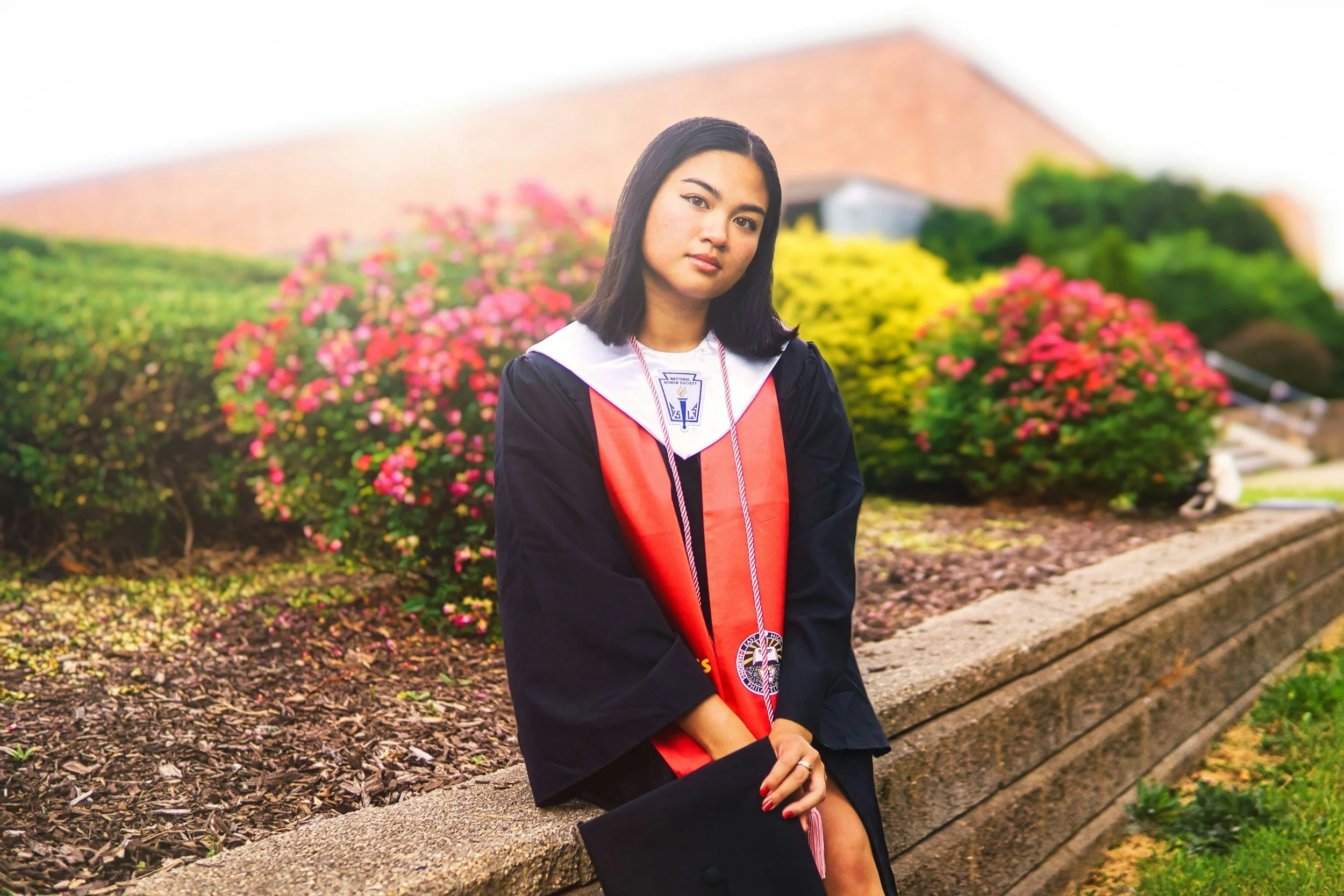
Authors who resonate at this age
Joanne Michelle Fernandez Ocampo — “The Dynamics of Defining Success and Failure” (DISRUPT 3.0) — permission to define your own scoreboard.
Alicia del Prado, Ph.D. — “Follow Your Heart: Leadership Lessons” (DISRUPT 4.0) — a psychologist on trusting your inner compass.
Joyce Rivera Javier, MD — “For Us, By Us: From Listening to Leadership” (DISRUPT 4.0) — Filipino mental health, finally on the page.
Michelle Florendo — “The Old Rules No Longer Apply” (DISRUPT 2.0) — a decision engineer’s case for designing your own path.
Astrid S. Tuminez, Ph.D. — “A Filipina in a Word, a Filipina in the World” (DISRUPT) — from humble beginnings to global leadership; never be ashamed of where you started.
New Master’s Graduate Navigating the Job Search
I finished my master’s three months ago. I have a strong résumé, a LinkedIn profile I rewrite weekly, and an inbox of rejections that all use the word “unfortunately.” A friend from my program handed me DISRUPT 2.0, opened to one chapter: Trish Quema La Chica’s “Surviving San Francisco: How I Landed My Dream Job at 28.” Reader, I finished it standing in her kitchen.
That chapter alone earns the series a place on every job-seeker’s desk — the false starts, the survival jobs, the mentors earned by showing up, and the realization that leaving home was the price of growing.
But the deeper value is the pattern across all five books: nobody’s path was linear. Ana Bel Mayo landed with five dollars in her pocket and built a career anyway.
Rachel Salinel’s “Purpose, Passion, and Pass It On” reframed my search — I stopped asking “who will take me?” and started asking “where does my purpose meet their problem?”
Michelle Florendo’s decision-engineering lens is the practical tool I now use on every offer and every “should I even apply?” spiral.
And Cynthia Rapaido’s journey from military brat to educational leader reminded me that a winding early career isn’t a red flag; it’s range.
Two practical notes. First, the books are organized so you can read strategically — DISRUPT 2.0 is structured around actual leadership competencies (the same framework career coaches charge for).
Second, the authors are a living network: these are FWN awardees who femtor, speak, and answer DMs. This isn’t just a book series; it’s the warmest professional network I’ve ever walked into through a bibliography. Five stars, and bring a highlighter.
Authors who resonate at this stage
Charina Amunxategui — “I Am Enough” (DISRUPT 5.0) — the antidote to early-career impostor syndrome.
Sofia Aragon, JD, RN — “Wandering Off the Plantation” (DISRUPT 5.0) — naming workplace bias with precision and leading through it.
Aurora Abella-Austriaco — “Being a Filipina Litigator in a Sea of Dark Blue Suits” (DISRUPT 2.0) — commanding rooms not built for you.
Sonia T. Delen — “From Boondock to Boardroom” (DISRUPT) — the early-career climb, mapped end to end.
Marie Claire Lim Moore — “Positively Filipina” (DISRUPT 2.0) — is bringing your whole culture to a corporate career.
Kristine Custodio Suero — “Overcoming ‘JUST’” (DISRUPT 5.0) — underestimation as a strategic advantage.